The Storm Nobody Predicted — A UAE Builder’s Wake-Up Call
In April 2024, the UAE experienced something that stopped the country in its tracks. A single storm — unprecedented in recorded history — dropped more than a year’s worth of rainfall across parts of Dubai in under 24 hours. Roads became rivers. Tunnels flooded. And in buildings across the city, from newly completed towers to decade-old villas, the same thing happened: water found every gap, every crack, every inadequately sealed joint it could — and it got in.
Property managers reported hundreds of calls in a single day. Ceiling tiles collapsed. Basement car parks filled with water. Lifts failed. Insulation soaked through and lost its performance rating overnight. For many building owners, it was the first time they truly understood what waterproofing failure looks like at scale — and how expensive it is when it happens all at once.
But here is the thing: that storm did not create those vulnerabilities. It only revealed them. The cracks in the membrane, the deteriorated sealants, the inadequately detailed upstands — they were already there, silently waiting for a trigger. Waterproofing in UAE is not something you think about when the sun is blazing. It is the thing that saves your building when the weather does something nobody expected.
“The April 2024 storm did not break buildings that were properly waterproofed. It exposed the ones that were not.”
What the UAE Climate Actually Does to Your Building
To understand reason for waterproofing in UAE is so critical, you need to understand what the climate is actually doing to your building envelope — not just during a storm, but every single day of the year. The UAE’s weather is not merely hot. It is a combination of thermal, chemical, and mechanical stressors that work on building materials constantly, and in ways that are not always visible until significant damage has already occurred.
Thermal cycling. UAE buildings experience temperature swings of 20 to 30 degrees Celsius between day and night during certain seasons. Every one of those cycles causes building materials to expand and contract. Over months and years, this repeated movement opens micro-cracks in concrete, works sealants out of joints, and causes membrane edges to lift. This is not dramatic damage — it is slow, cumulative, and invisible until it is not.
UV degradation. The UAE receives some of the highest levels of solar ultraviolet radiation on earth. UV breaks down the polymer chains in waterproofing membranes, sealants, and coatings — reducing their flexibility, causing surface crazing, and ultimately leading to cracking and delamination. A membrane that is not UV-stabilised or UV-protected will lose a significant portion of its performance within three to five years of installation in a UAE rooftop environment.
Coastal salinity. For buildings within several kilometres of the coast — which includes the vast majority of developed areas in Dubai, Abu Dhabi, Sharjah, and the other Emirates — airborne salt particles are a constant presence. Salt is hygroscopic, meaning it attracts and holds moisture. It is also chemically aggressive to concrete, causing carbonation and reinforcement corrosion over time. Salt-laden air also accelerates the degradation of sealants and membrane adhesives. For coastal buildings, waterproofing in UAE is not just about keeping rain out — it is about managing a chemical environment that never stops working on the building fabric.
Groundwater pressure. In areas with a high water table — common in coastal zones and reclaimed land areas across the UAE — buildings face hydrostatic pressure from below as well as water entry from above. Basement slabs, pile caps, retaining walls, and lift pits in these areas are under constant upward pressure from water in the ground. Without below-grade waterproofing systems designed specifically for hydrostatic conditions, these elements will eventually leak — and remediation after the fact is one of the most complex and expensive interventions in construction.
The 6 Most Vulnerable Points in Any UAE Building
Water is patient and it is opportunistic. It will find the weakest point in any building envelope and exploit it. Based on years of delivering waterproofing in UAE across every property type and emirate, these are the six locations where failure is most commonly found — and where prevention delivers the greatest value.
1. Flat rooftops. Almost every building in the UAE has a flat roof, and flat roofs are the most common source of waterproofing failure by a significant margin. Water ponds on improperly sloped rooftops, sitting in contact with the membrane for extended periods and finding every imperfection. Poor detailing at upstands, drains, and penetrations creates pathways that even a correctly specified membrane cannot compensate for. A flat roof waterproofing system is only as good as its worst detail.
2. Basement and below-grade structures. Basements face water entry from all directions simultaneously — through the slab from below, through walls from the sides, and through construction joints between pour sequences. In areas with a high water table, the hydrostatic pressure on a basement slab can be equivalent to several metres of water head. Without a properly designed waterproofing system that accounts for this pressure, basement leaks are not a question of if — they are a question of when.
3. Wet areas. Bathrooms, kitchens, laundry rooms, and plant rooms are the most common source of water damage in residential buildings. Waterproofing failures in wet areas are typically caused by inadequate substrate preparation, insufficient membrane coverage at floor-to-wall junctions, or the use of tile adhesive and grout alone as a “waterproofing” layer — which they are not. In a country where properties can sit in the sun for months before a leak manifests, wet area waterproofing failures are often discovered only when the damage has already reached the floor below.
4. Water tanks and swimming pools. Potable water tanks and pools are in constant contact with water on their interior faces and exposed to thermal cycling and UV on their exterior faces. Inadequate waterproofing in these structures results in contamination of stored water, loss of structural integrity through reinforcement corrosion, and in the case of pools, significant ongoing water loss. The waterproofing system for a tank or pool must be compatible with the stored medium — not all membranes are suitable for potable water contact.
5. External façades and balconies. Balcony slabs are exposed on three faces — top surface, underside, and edge — making them particularly vulnerable to water entry and freeze-thaw damage in cooler months at altitude. Facade cladding systems with inadequate sealant joints and insufficient backup waterproofing allow wind-driven rain to penetrate behind the cladding, soaking insulation and reaching the structural substrate. In a coastal environment, this water carries salt — accelerating every damage mechanism simultaneously.
6. Construction joints and penetrations. Every joint between concrete pours, every pipe and conduit penetrating a waterproofed element, and every drain or roof outlet is a potential failure point. These transitions require specific waterproofing treatments — flexible sealants, waterstop profiles, formed collars, and carefully detailed membrane terminations — that are often under-specified or under-installed. They are also the locations that are most frequently compromised during construction by trades working after the waterproofing contractor.
“Water does not need a large opening to cause significant damage. A hairline crack in a membrane upstand is enough — given sufficient time and hydrostatic pressure.”
The Hidden Cost of Ignoring Waterproofing
The financial argument for proper reason for waterproofing in UAE is one of the most compelling in all of building maintenance — and one of the most consistently underestimated. Industry data consistently shows that the cost of remediating waterproofing failure is three to five times the cost of the original correct installation. For a rooftop waterproofing system that should have cost AED 80,000 to install properly, the remediation — including stripping existing finishes, drying out saturated insulation, treating corroded reinforcement, reapplying the membrane, and reinstating the surface — can easily reach AED 300,000 to AED 400,000.
But the direct cost of repair is only part of the picture. Water ingress in occupied buildings causes business interruption, tenant complaints, and in serious cases, legal liability. In residential properties, ceiling damage, mould growth, and structural staining reduce property values and trigger disputes between owners and building management. In commercial buildings, water damage to IT equipment, stock, or machinery can cause losses that dwarf the cost of any waterproofing system. According to research cited by the Whole Building Design Guide, water intrusion is the single most common cause of building envelope failures globally — and the UAE’s climate makes local buildings more vulnerable than most.
Then there is the insurance dimension. Many property insurance policies in the UAE carry exclusions or sub-limits for water damage caused by inadequate maintenance or original construction defects. A building owner who has not maintained their waterproofing system — or whose original system was inadequately specified — may find themselves without coverage precisely when they need it most.
Flash Floods — The Threat That Changed Everything
For decades, the conventional wisdom in UAE construction was that rain was too infrequent and too light to justify the reason for waterproofing in UAE investment that wetter climates demanded. The April 2024 event permanently retired that assumption. Now no 1 reason for Waterproofing in UAE has to be designed not for the average year but for the exceptional one — because the exceptional years are becoming less exceptional.
Climate scientists tracking rainfall patterns across the Arabian Peninsula have noted an increase in the frequency and intensity of convective rainfall events — the type of intense, localised downpours that produce flash flooding. The UAE’s infrastructure — drainage systems, road gradients, and building waterproofing details — was not universally designed for these events. The buildings that survived April 2024 with minimal damage were the ones whose waterproofing systems had been correctly specified for positive water pressure, properly detailed at every penetration and joint, and maintained to a standard that kept them performing as designed.
The lesson for building owners and developers is clear: the question is no longer whether a UAE building will experience significant rainfall events during its design life. It is whether the building is ready for them when they arrive.
Coastal Properties: A Whole Different Level of Risk
If you own or manage a property within sight of the sea — or within two to three kilometers of the coastline — your building have a reason for waterproofing in UAE, it face the challenge that inland properties do not. The combination of direct wave action or splash zone exposure, airborne salt spray, elevated permanent humidity, and corrosive groundwater creates an environment that degrades conventional waterproofing systems significantly faster than standard UAE conditions. Proper reason for waterproofing in UAE for coastal buildings requires systems specifically rated for marine exposure — membranes with enhanced chemical resistance, sealants formulated for salt-laden environments, and detailing that accounts for the additional hydrostatic and lateral water pressures that coastal ground conditions produce.
The developments at Dubai Creek Harbour, Palm Jumeirah, Saadiyat Island, and Yas Island — among the most valuable real estate in the country — all sit in environments where waterproofing system selection is a critical engineering decision, not a commodity purchase. The difference between a system that lasts twenty-five years and one that begins to fail in eight years is almost entirely in the specification and the installation quality — not the area of membrane applied.
How Proper Waterproofing Actually Works
There is a widespread misconception that waterproofing is simply about applying a membrane to a surface. In reality, effective waterproofing in UAE is a system — a combination of material selection, surface preparation, application technique, joint treatment, and detailing that work together to create a continuous, durable barrier against water ingress. Every element of that system matters, and the failure of any one element can compromise the entire assembly.
The process begins with diagnosis — understanding where water is entering or is likely to enter, what the hydrostatic conditions are, what the substrate consists of, and what the exposure environment will subject the system to over its design life. This diagnostic stage is what separates a durable waterproofing installation from one that passes a handover inspection and fails eighteen months later.
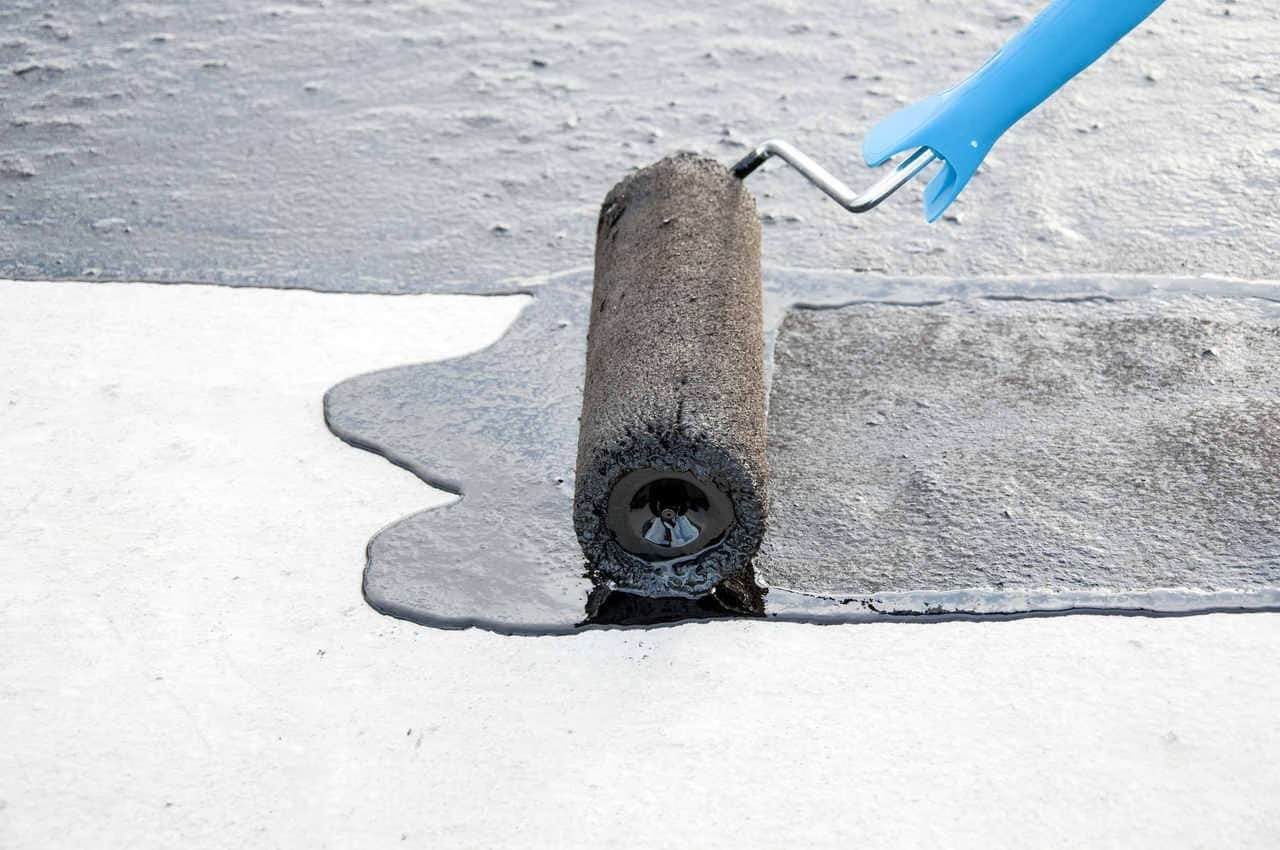
Surface preparation follows — and it is the step most often compromised in the UAE’s fast-paced construction environment. A membrane applied to a contaminated, damp, or structurally compromised substrate will debond prematurely. Concrete must be clean, dry, and free from laitance. Cracks must be repaired. Penetrations must be prepared. Only then is the primary membrane system applied — at the specified thickness, with the specified overlap at joints, and with the specified treatment at every transition and termination.
The ASTM International waterproofing standards that underpin UAE building specifications define minimum performance requirements for each system type — elongation, tensile strength, water absorption, and resistance to hydrostatic pressure. A correctly specified and installed system that meets these benchmarks will perform for fifteen to twenty-five years in UAE conditions. One that does not may not make it to five.
Waterproofing and Your Building’s Value
Property buyers and valuers in the UAE are increasingly sophisticated about building condition. A building with a documented waterproofing maintenance history, unexpired system warranties, and no history of water ingress commands a premium — both in sale value and in rental yield — over an equivalent building whose waterproofing history is unknown or problematic. For developers selling off-plan or completed units, the quality of the waterproofing system is part of the product quality narrative that influences buyer confidence and reduces post-handover defect claims.
For facility managers and building owners responsible for portfolios of assets, waterproofing in UAE maintenance is increasingly being recognised as a core asset management activity — not a reactive cost triggered by leaks, but a planned programme of inspection, maintenance, and system replacement that protects and sustains the value of the portfolio over time. This shift from reactive to proactive is the single biggest change in how sophisticated property owners in the UAE approach building protection.
What to Ask Before Hiring a Waterproofing Contractor
Not all waterproofing in UAE is equal — and not all contractors who offer it are equally capable of delivering it. Before you appoint a waterproofing contractor for any project, these are the questions that will separate the technically competent from the merely available.
What system are you recommending, and why? A contractor who cannot explain the specific reasons for their system selection — the substrate condition, the exposure class, the hydrostatic requirements — is specifying generically, not diagnostically. Generic specifications produce generic results.
What surface preparation does your specification require? The answer to this question tells you immediately how seriously a contractor takes the installation process. If the answer is vague — “we’ll clean it up” — that is a warning sign. Preparation protocols should be specific and documented.
What manufacturer’s product are you using, and can you provide the technical data sheet? Certified, traceable materials are the foundation of a durable waterproofing installation. If a contractor cannot name the product and provide its technical documentation, they are either using uncertified materials or they do not know what they are applying.
Do you provide a warranty, and what does it cover? A contractor who stands behind their work will provide a warranty that covers both materials and installation. One who does not is telling you something important about how confident they are in what they are delivering.
Can you provide references from projects completed twelve months or more ago? Recent references tell you about the experience of working with a contractor. References from completed projects that have been through at least one UAE summer and rain season tell you whether the work held.
Your Building Needs Protection Before the Next Storm Decides for You
The April 2024 rainfall event was a reminder, not an anomaly. The UAE’s climate is capable of delivering stresses to buildings that most owners have never planned for — and the buildings that survived with minimal damage were the ones whose waterproofing in UAE had been taken seriously from the beginning. The ones that did not survive taught their owners an expensive lesson about the cost of prevention versus the cost of cure.
Whether your building is newly completed and needs a thorough waterproofing inspection before the next season, a decade old and overdue for a membrane assessment, or mid-construction and at the critical stage where waterproofing decisions are being made — Alam Almadina LLC is ready to help. We deliver certified waterproofing solutions across all seven emirates, for every property type, using materials and methods that are specified for the UAE’s specific and demanding climate conditions. Contact us today for a free site inspection and find out exactly where your building stands — before the weather tells you first.
Leave a Reply